
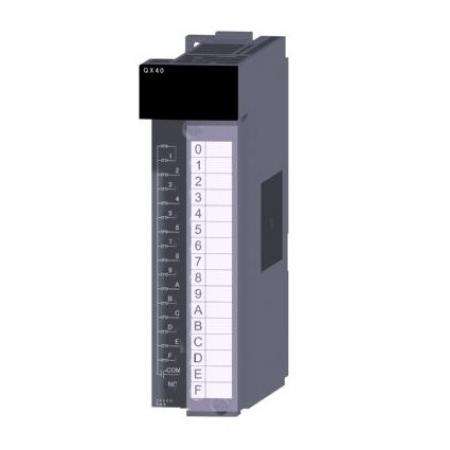
QX40
Mô đun 16DI
Input modules, Interrupt modul
| Point | DC input | DC/AC input | AC input | |||||
|---|---|---|---|---|---|---|---|---|
| 5 V DC | 5/12 V DC | 24 V DC | 48 V DC/AC | 100…120 V AC | 100…120 V AC | |||
| Positive | Negative | Positive/ Negative | Positive | Negative | Positive/ Negative | |||
| 8 points | — | — | — | QX48Y57*1 | — | — | — | QX28 |
| 16 points | QX70H | QX90H | QX70 | QX40 QX40-TS QX40-S1 QX40H QI60 | QX80 QX80H QX80-TS | QX50 | QX10 QX10-TS | — |
| 32 points | — | — | QX71 | QX41 QX41-S1 QX41-S2 QH42P*1 QX41Y41P*1 | QX81 QX81-S2 | — | — | — |
| 64 points | — | — | QX72 | QX42 QX42-S1 | QX82 QX82-S1 | — | — | — |
*1: Input specifications for I/O combined modules
Output modules
| Point | Contact output | TRIAC output | Transistor output | ||||
|---|---|---|---|---|---|---|---|
| 24 V DC, 240 V AC | 100…240 V AC | 5…12 V DC | 5…24 V DC | 12…24 V DC | |||
| Sink type | Sink type | Sink/Source type | Sink type | Source type | |||
| 7 points | — | — | — | — | — | QX48Y57*2 | — |
| 8 points | QY18A | — | — | — | QY68A | — | — |
| 16 points | QY10 QY10-TS | QY22 | QY70 | — | — | QY40P QY40P-TS QY50 | QY80 QY80-TS |
| 32 points | — | — | QY71 | QY41H | — | QY41P QH42P*2 QX41Y41P*2 | QY81P |
| 64 points | — | — | — | — | — | QY42P | QY82P |
*2: Output specifications for I/O combined modules
●High speed DC input module (positive common type)QX40HQX70H
●High speed DC input module (negative common type)QX80HQX90H
Speed up control by catching the input signal variation at 0 ms*3.
Two devices with differing power systems can be connected to the same module using different 8 point common terminals.
*3: The actual response time is 5 µs delay when turning ON, 10 µs delay when turning OFF, because the hardware response time is added.
| Common type | Input voltage | |
|---|---|---|
| 24 V DC | 5 V DC | |
| Positive | QX40H | QX70H |
| Negative | QX80H | QX90H |
●Spring clamp terminal block type input moduleQX10-TSQX40-TSQX80-TS
●Spring clamp terminal block type output moduleQY10-TSQY40P-TSQY80-TS
Spring clamp terminal blocks visually indicate the connection status. Also, by eliminating screws, wiring and maintenance work is made easier.

Advantages of spring clamp terminal blocks
- Impervious to vibration, secured wiring connections.
- Eliminating screws greatly simplifies conventional maintenance.









Reviews
There are no reviews yet.